Thursday, January 10, 2019

Old Friends, New Hobby - Part 1

1/3/19 

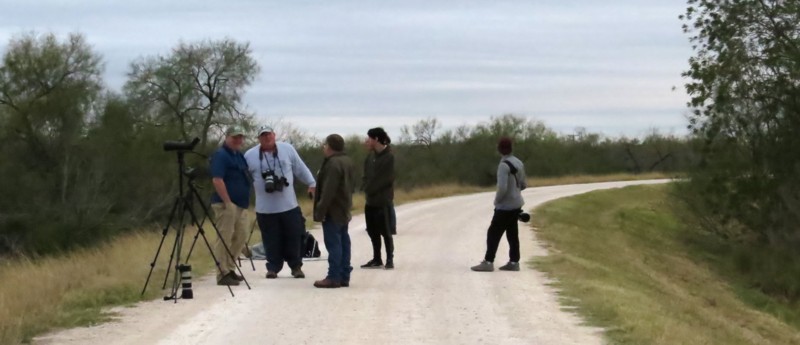
Barbara and Julia had been friends since age four, but it was only recently that the latter got the former into birding, so they were both down during a break in the academic year to see some new birds!  Julia had traveled the world and had seen many of our “semi-specialties” in Arizona (and even Costa Rica!), but almost everything was new for Barbara!  I had planned the standard tour, but decided to check the now-famous levee for the Hook-billed Kites!  It was even colder and windier than when Sue and Billy and I had come last Saturday, but unlike last Saturday, the birds were a no-show for the half hour we gave it (and the birds apparently hadn’t been seen the day before, which didn’t bode well).  But it wasn’t a waste as far as my charges were concerned:  every little feather was special!  Right off the bat an Anhinga flapped overhead, a pair of Altamira Orioles gave great views, and Green Jays entertained.  A brilliant Vermilion Flycatcher gave some a brief view as did a peeping Black Phoebe, and a Marsh Wren sang unseen.  We heard a Red-shouldered Hawk yelling, but never spotted it.  A male Ladder-backed Woodpecker put on a great show in a dead tree right next to the levee, while a female Golden-fronted was further back in the woods.  On the way back to the car two Tricolored Herons flew overhead.

Looking for Hook-billed Kites along the now-famous levee

We finally decided to head to the feeders at Bentsen, where the most action seemed to be right in the parking lot:  a whole herd of Chachalacas came running over, and were promptly bullied by a Mockingbird!  That was a first!  A tree full of American Goldfinches had a few House Finches in with them, which shortly joined a big flock of Lark Sparrows and even more House Finches on the ground, and the males had a variety of colors, from orange to rose!  At the canal the Black Phoebes were way down there and showing only when they flew over the water, so we continued to the Nature Center Feeders to see what would come in.  An Orange-crowned Warbler was checking out the empty peanut butter feeder, but the east side had more action, with several White-tipped Doves on the ground, more orioles and jays, plus Cardinals adding to the color!  A couple of Chachalacas came in as well, along with a pretty Golden-fronted Woodpecker.  On the way out the Black Phoebe was more cooperative, and a Buff-bellied Hummingbird gave a brief appearance at the tram stop, along with an Olive Sparrow on the ground!

American Goldfinches

House Finches (still considered rare in the Valley but are becoming somewhat expected in some places); rosy ones...

...and an orange one!

Altamira Oriole

White-tipped Dove

Golden-fronted Woodpecker


Chachalacas vs. Mockingbird...

From there we headed down Old Military Highway towards Anzalduas.  I heard a Couch’s Kingbird pupping in the sunflower field, so we piled out and got brief views as he flew off, but a flock of Lesser Goldfinches feeding on the sunflowers stole the show!  We took the levee to Anzalduas, and the girls were duly impressed with the view of the Rio Grande, but we didn’t pick up much bird-wise until we got to the “hawk field”, where the numbers were down from Saturday but we still picked up several White-tailed Hawks (mostly juvies), some Caracaras, and a distant young Redtail in a tree.  There were some other birders there, and one gentleman got on a distant hovering hawk that he thought might be the Ferruginous, so we all tracked it until it finally came closer and landed in the field to the north, showing us the nice white pitagials!  Another lifer for the girls!  Heading down the entrance road I casually waved to another carload of birders and stopped for some Savannah Sparrows, when the car suddenly started backing up and parked right next to us – it was my friend Tamie and Father Tom! J  Didn’t realize who it was when we passed them, and they weren’t gonna let me get away without saying hi! J

Distant immature Ferruginous Hawk, accidental in the Valley

The park was open today, but Julia had already seen Sprague’s Pipit in Arizona (and none of us were thrilled with the idea of tromping across the field in that bitter wind), so we car birded the park; no kingfishers on the river, but we did see a nice Osprey, and the girls picked up a couple of Coots.  Loggerhead Shrikes were quite cute and fluffy, but the highlight here was no less than three Vermilion Flycatchers (one a bright, full adult male)!  A titmouse came out at one feeding flock that we stopped for, but not long enough for everyone to get a good look… L  

Young male Vermilion Flycatcher

Looking for the titmice..

Barb and me (photo © 2019 by Julia Corbett)

Julia and Barb (photo © 2019 by Julia Corbett, even though I took it... 😄)

We discussed options after that and decided to go to Santa Ana, but not before Barbara spotted a Coyote trotting across the “pipit field” on the way out!  Billy had pointed out the Harris’ Hawk pair Bill Clark had banded and that had a territory along busy Military Highway, so I was keeping an eye out for them along the way, and there he was on a wire!  We detoured to Hidalgo for the Monk Parakeets (a flock of Green Parakeets had shot over the freeway on the way to Mission, but the girls couldn’t discern them in the gloom), and Barbara was amazed at the pretty winter pattern of the Starling (I think she described them as “greasy black” back home J)!  It was still cool and breezy at the refuge, but some little things were moving here and there along the trail; we didn’t run into the Golden-crowned Kinglet, but we had the Ruby-crowned along with Orange-crowned and Yellow-rumped Warblers.  Three Common Ground Doves flushed into a tree and gave us scope views, and I heard a Beardless Tyrannulet that of course didn’t wanna play ball, as did a fussing Long-billed Thrasher and a couple of song-battling White-eyed Vireos.  What was cooperative to my surprise was a brilliant Verdin overhead!

Coyote hightailing it across the field

Willow Lakes contained their life Mottled Ducks and Least Grebes (the latter was a big target), along with the usual Gadwall, Shovelers, and both Blue-winged and Cinnamon Teal (interestingly, the latter was not a lifer for either one).  Shorebirds included Black-necked Stilts, several Greater Yellowlegs, and pods of Long-billed Dowitchers across the way.  Soras were crying all over, and as we approached the final deck, Julia grabbed me by the jacket and pulled me back – she had spotted a Green Kingfisher on the culvert!  We saw her dart away, but thankfully she shortly came back and gave everyone great views!  On the hike back I pointed out the tree snails that are the staple Hook-billed Kite diet.


Julia shoots a tree snail (below), staple of the Hook-billed Kite!


Northern Shoveler

Consulting the bird app...

Since the Ringed Kingfisher was high on their list, we decided to head to Edinburg Wetlands for our last stop.  Hoping to scare up more songbirds (and scaring up a Zebra Heliconian instead), we took the long way to the north pond, where we added both flavors of cormorant, lots of Snowy Egrets, several White Pelicans, and a couple of Black-crowned Night Herons.  I planted the girls at the observation deck while I ran to the facilities, and by the time I got back they had found the Ringed Kingfisher down by the spillway, along with a Belted!  We decided to go down to that observation platform to get a better look, but on the way discovered a pod of Roseate Spoonbills in the canal!  The Snowy Egrets with them were quite fluffy as well, but as we watched yet another Green Kingfisher ticked from the branches!  (Another Buff-bellied Hummer also made a brief appearance at the feeder…)

Zebra Heliconian

Young Roseate Spoonbills

Fluffy Snowy Egrets


Heading on down to the platform, we got great looks at the Ringed Kingfisher (“tangerine” colored, one of them quipped J), along with great comparative looks at both cormorants decorating one of the trees across the way!  While Barbara visited the facilities Julia and I headed down the canal trail and eventually to the little blind near the entrance; a Wilson’s Warbler gave great views, but something batted around that I just couldn’t place – it looked and acted like a White-eyed Vireo put with no color and a plainer face!  The girls didn’t let me live that one down as I was totally stumped!  Best I could guess was a young White-eyed, as I recall those buggers fooling many of us in times past, making us think we had a Bell’s a first!

Ringed Kingfisher

Headed home after that, with 85 species for the day!  Bird list:

Blue-winged Teal 
Cinnamon Teal 
Northern Shoveler 
Gadwall 
Mottled Duck 
Northern Pintail 
Plain Chachalaca 
Least Grebe 
Pied-billed Grebe 
Rock Pigeon
Common Ground-Dove 
White-tipped Dove 
Mourning Dove 
Buff-bellied Hummingbird 
Sora 
American Coot 
Black-necked Stilt 
Killdeer 
Long-billed Dowitcher 
Greater Yellowlegs 
Anhinga 
Neotropic Cormorant 
Double-crested Cormorant 
American White Pelican 
Great Blue Heron 
Great Egret 
Snowy Egret 
Tricolored Heron 
Cattle Egret 
Black-crowned Night-Heron 
Roseate Spoonbill 
Black Vulture 
Turkey Vulture 
Osprey 
Northern Harrier 
Harris's Hawk 
White-tailed Hawk 
Red-shouldered Hawk 
Red-tailed Hawk 
Ferruginous Hawk 
Ringed Kingfisher 
Belted Kingfisher 
Green Kingfisher 
Golden-fronted Woodpecker 
Ladder-backed Woodpecker 
Crested Caracara 
American Kestrel 
Monk Parakeet 
Green Parakeet 
Northern Beardless-Tyrannulet 
Black Phoebe 
Eastern Phoebe 
Vermilion Flycatcher 
Great Kiskadee 
Couch's Kingbird 
Loggerhead Shrike 
White-eyed Vireo 
Green Jay 
Black-crested Titmouse 
Verdin 
House Wren 
Marsh Wren 
Blue-gray Gnatcatcher 
Ruby-crowned Kinglet 
Long-billed Thrasher 
Northern Mockingbird 
European Starling 
American Pipit 
House Finch 
Lesser Goldfinch 
American Goldfinch 
Olive Sparrow 
Lark Sparrow 
Savannah Sparrow 
Lincoln's Sparrow 
Western Meadowlark 
Altamira Oriole 
Red-winged Blackbird 
Great-tailed Grackle 
Orange-crowned Warbler 
Common Yellowthroat 
Yellow-rumped Warbler 
Wilson's Warbler 
Northern Cardinal 
House Sparrow 

Monday, December 31, 2018

End-of-the-Year Chase Day

12/29/18 

Ever since Barbara had cottoned me onto the fact that you could use eBird to figure out what you still needed for the year, the thought of doing a “clean up chase day” on my last birding day of the year sounded like fun!  It also sounded fun to Sue and Billy, so between Christmas and Saturday Sue and I came up with a target list and I plotted a course that hopefully would bag us most of our birds!

We knew another cold front was coming through, but we didn’t count on it being quite so cold and windy! L  We made a quick stop at Bentsen (it wasn’t even sunrise yet) and picked up the Black Phoebe pair for the day along with a rattling Buff-bellied Hummingbird, then headed over to the famous levee near the Butterfly Center where the Hook-billed Kites were being fairly regular!  Several others were there, including a FWS guy from Maine and a young visiting teen whose non-birder mom was acting as chauffeur to help him get his Valley specialties!  We all shot the breeze for the longest time, adding a handful of vocalizing birds (including our only Long-billed Thrashers of the day), when the “birding mom”, who was several yards to our east, said, “What’s that dark bird down there?  Is that it?”  Everyone scrambled to her position, and sure enough, the dark morph Hook-billed Kite was out in the open but down in a tree (and totally blocked from where the rest of us were)!  Cameras went bonkers, and before long he flew up into the “traditional” tree along with another bird, giving everyone wonderful looks!  Unfortunately it was still rather gloomy, so the pictures left a lot to be desired…

Waiting for the show...

The Hook-billed Kite shows up down in the brush!  (Video grab)

Another bird up in the "regular" tree
  
Since we were close we made a quick stop at the pond on Inspiration Drive, which was quite productive:  we added the only Ring-necked Ducks and Common Gallinules of the day, along with Pied-billed Grebes, Great Blue Herons, and several other ducks.  From there we headed to Anzalduas, where the day before a young Ferruginous Hawk was reported (by the same visiting kid) in the field north of the park!  So we rolled over and found tons of Red-tailed and White-tailed Hawks, along with Caracaras, but sure enough, one very pale bird turned out to be the Ferrugie!  One Caracara got a little too close and the Ferrugie lunged at him, showing off the diagnostic pale pitagials!  

Caracara checking out this strange visitor...

These video grabs show the plain patagials (area on the leading edge of the wing), which separate the juvenile Ferruginous Hawk from the pale "Krider's" Hawk


And if you use your imagination, you can see the feathered tarsus on this bird, which also separates it Krider's (also a video grab)
  
We headed up onto the levee to go into the park, only to discover it was closed (and it wasn’t even New Year’s yet)!! L  So since that shot our best chance at Sprague’s Pipit (Pine Siskin was a longshot, as it hadn’t been reported in almost a month), we continued to Granjeño, where Billy and Sue took me up the back road where they and Bill Clark had caught and banded a Harlan’s Hawk!  (Bill, who literally wrote the book on North American raptors, had been studying them for over 20 years and was making a strong case for them to be split off again from Red-tailed…)  But first we were distracted by an adult Swainson’s Hawk in the field along with several more Whitetails and Caracaras, plus a distant Peregrine perched near the Anzalduas Bridge!  Shortly we noticed an all-dark raptor on a pole, and while we didn’t notice it at the time, the pictures revealed that he was indeed banded – we had our bird!

Fuzzy Swainson's Hawk (a few usually spend the winter)

Juvenile Harlan's Hawk (look carefully for the band on his right leg!)

From there we drove up onto the levee for another longshot (the reported Short-eared Owl), but we at least got a pair of distant White-tailed Kites, plus the wintering Burrowing Owl thanks to Billy’s sharp eyes!  On the way to Santa Ana we added a few White Pelicans circling over Military Highway, and then made a quick run through Hidalgo to pick up the Monk Parakeets, also picking up the day’s only Caspian Tern overhead (and I think this is also where they got their Curve-billed Thrasher that I missed).  Once at the refuge we took the Chachalaca Trail to Willow Lakes, where we ran into another couple who pointed out a feeding flock that included American Goldfinches and a Verdin, but also the coveted Golden-crowned Kinglet (a lifer for Billy and a year bird for Sue), so that was very exciting!  The lakes themselves had a good collection of ducks, including three Cinnamon Teal, but alas, not the Wood Duck.  Billy thought he had a Say’s Phoebe that morphed into a female Vermilion Flycatcher (that happens a lot J), and a little pod of Least Grebes poured on the cuteness!  Sue and I kept track of the Soras and Yellowthroats while Billy chewed the fat with the gentleman (also named Bill)!  After parting company we enjoyed a pair of Solitary Sandpipers at the last deck, and several Greater Yellowlegs and a Spotted Sandpiper further along the Tower Trail.

Sue checking the spillway

Meanwhile Billy spots the Burrowing Owl!


Monk Parakeets

Least Grebe

Solitary Sandpiper


We finally headed out to Pintail Lakes, enjoying a friendly pair of Ladder-backed Woodpeckers on the cutover trail, but the wind was fierce; we braved the trail out to the closest lake, hoping against hope to flush a Sprague’s Pipit or Vesper Sparrow (we did get several American Pipits to pop up), but it wasn’t to be; even the lake was rather uninspiring.  So rather than hike all the way out to the last lake we headed back along the tour road, adding a White-tipped Dove beating feet, a calling Carolina Wren, and a family group of Chachalacas making like Roadrunners as they dashed across the road!  

Billy and Sue checking out Pintail Lake

We were getting hungry so we decided to go to Nana’s in Weslaco for lunch (which was wonderful – real Mexican according to Billy J), picking up our only Inca Doves of the day.  Several targets had been reported at Estero, but it was just too cold and blustery to do any more hiking, so we opted to head up to Sugarhouse Pond for a hopeful Eared Grebe.

Well.  The water was high and there was not one bird in the pond (except a distant Great Egret)!  So we opted to check out the “1015 Pond” behind Delta Lake, only a huge flock of Long-billed Curlews made us grind to a halt at the “Tri-County Pond” (an intersection literally at the corners of Cameron, Willacy, and Hidalgo Counties)!  There were also several more White-tailed Hawks in the fields (I think today definitely broke a personal record)!

Trio of White-tailed Hawks

Crested Caracara

Somehow I got turned around, but we eventually made it to FM 1015 and up to the pond, only we couldn’t believe it:  the pond was being “used” by a huge group of ATVers who were actually getting themselves stuck in the water (whether on purpose or not we had no idea) and being watched by an even bigger crowd of spectactors!  This was all on the opposite side of where we were (thankfully), but I didn’t even think that back area was accessible – obviously it is!  But so much for logging any special birds…

ATVs playing in the water (with a slew of onlookers)


So from there we headed to Rio Beef Road in hopes of at least a Ross’ Goose for Sue (and I think she said Brewer’s Blackbird was a year bird, too) where we picked up a scolding Bewick’s Wren and Couch’s Kingbird, then checked out the “barren field pond” on Ken Baker Road, which only had Pintail and a couple of Mottled Ducks.  We couldn’t find any Brewer’s outside the Rio Beef gate, but heading back onto the main road we had several females on the wires!  We had heard Snow Geese while at the gate, and once on the main road someone spotted a distant flock, which miraculously came at us and circled around!  Even better was the fact that there were two obviously smaller geese in with them – the Ross’!  That happened to be a lifer for Billy as well!  The little wet spot there held Black-necked Stilts and a few Avocets; Billy caught sight of some distant cranes, but I missed those…

Female Brewer's Blackbirds
  
We had to scoot after that, but not before picking up several Harris’ Hawks on the way down Brushline!  Between the three of us we logged 91 species for the day!!  Bird list:

Snow Goose 
Ross's Goose 
Blue-winged Teal 
Cinnamon Teal 
Northern Shoveler 
Gadwall 
Mottled Duck 
Northern Pintail 
Ring-necked Duck 
Plain Chachalaca 
Least Grebe 
Pied-billed Grebe 
Rock Pigeon
Eurasian Collared-Dove 
Inca Dove 
White-tipped Dove 
White-winged Dove
Mourning Dove 
Buff-bellied Hummingbird 
Sandhill Crane
Sora 
Common Gallinule 
American Coot 
Black-necked Stilt 
American Avocet 
Killdeer 
Long-billed Curlew 
Least Sandpiper 
Long-billed Dowitcher 
Spotted Sandpiper 
Solitary Sandpiper 
Greater Yellowlegs 
Lesser Yellowlegs 
Caspian Tern 
Neotropic Cormorant 
American White Pelican 
Great Blue Heron 
Great Egret 
Black Vulture 
Turkey Vulture 
White-tailed Kite 
Hook-billed Kite
Northern Harrier 
Harris's Hawk 
White-tailed Hawk 
Swainson's Hawk 
Red-tailed Hawk 
“Harlan’s” Hawk
Ferruginous Hawk 
Burrowing Owl 
Belted Kingfisher 
Golden-fronted Woodpecker 
Ladder-backed Woodpecker 
Crested Caracara 
American Kestrel 
Peregrine Falcon 
Monk Parakeet
Green Parakeet
Black Phoebe 
Eastern Phoebe 
Vermilion Flycatcher 
Great Kiskadee 
Couch's Kingbird 
Loggerhead Shrike 
White-eyed Vireo 
Green Jay 
Northern Rough-winged Swallow 
Black-crested Titmouse 
Verdin 
House Wren 
Marsh Wren 
Carolina Wren 
Bewick's Wren 
Blue-gray Gnatcatcher 
Golden-crowned Kinglet 
Ruby-crowned Kinglet 
Curve-billed Thrasher
Long-billed Thrasher 
Northern Mockingbird 
European Starling 
American Pipit 
American Goldfinch 
Olive Sparrow 
Lincoln's Sparrow 
Eastern Meadowlark
Western Meadowlark
Red-winged Blackbird 
Brewer's Blackbird 
Great-tailed Grackle 
Orange-crowned Warbler 
Common Yellowthroat 
Yellow-rumped Warbler 
Northern Cardinal 
House Sparrow